Bakit hindi matalu-talo ang New People’s Army?

Published by Bulatlat

Lahat ng rehimeng nagdaan ay nagtangkang buwagin at talunin ang New People’s Army (Bagong Hukbong Bayan). Lahat ay nagsabing sila’y magtatagumpay. Lahat sila’y nabigo. Ano ang nasa likod ng misteryong lakas ng NPA? Paano ito nagpunyagi sa nakalipas na limang dekada? Walang sikreto maliban sa puspusang pakikibaka habang sinusulong ang pulitika ng rebolusyon. Walang kakaibang doktrina maliban sa paglingkuran ang sambayanan hanggang magtagumpay ang pambansang demokratikong pakikibaka. Bakit hindi matatalo ang NPA? Narito ang ilang dahilan….

1. Dahil ang hukbong bayan ay kakampi ng mga magsasaka sa pagpapatupad ng tunay na reporma sa lupa. Sa minimum, binababa ang upa sa lupa at pinatataas ang kita ng magsasaka mula sa benta ng kanilang ani; at sa maksimum ay pamamahagi ng lupa. Kaya naman ang masa kinupkop ang NPA bilang kaibigan, kaanak, at kasama.

2. Dahil tagapagtanggol sila ng kalikasan. Kalaban ng mapanirang pagtotroso, malakihang pagmimina, at mga dayuhang korporasyong nagkakalat ng dumi sa kapaligiran. Kaya hindi nakapagtataka kung ang karaniwang tao ay sumasaludo sa malinis na rekord ng NPA.

3. Dahil ang NPA ay lubog sa pang araw-araw na buhay ng mamamayan sa kanayunan. Pwersang militar subalit mas abala sa pagtulong sa bukid, gawaing produksiyon, at pagtataguyod ng mga batayang serbisyo sa baryo tulad ng edukasyon, kalusugan, seguridad, at patubig.

4. Dahil bahagi ito ng pagbubuo ng gobyernong bayan; haligi ng pulang kapangyarihan sa mga pinalayang purok. Gobyernong may masaklaw na teritoryo, nagtatakda ng sariling batas, nagtatayo ng mga paaralang bayan at pagamutan. Pinagkakaisa ang hanay ng mamamayan upang wakasan ang pamumuno ng mga oligarkiya sa bansa.

5. Sumbungan ng bayan. Ang orihinal na 911 at 8888 sa kanayunan. Para sa mga problemang walang aksyon ang burukrasya, idinudulog sa NPA upang magkaroon ng mabilis na tugon at hustisya. Pwersang nagpaparusa sa mga despotikong panginoong maylupa, abusadong pulitiko, mabagsik na warlord, sundalong may utang na dugo, at mga kriminal tulad ng mga magnanakaw ng kalabaw. Nagpapatupad ng kaayusan, kapayapaan, at kumikilala sa pakikibakang masa sa kanayunan.

6. Bihira o halos walang NPA na kinamumuhian ng masa. Minsan ang tawag sa kanila ay ‘Nice People Around’. Bakit? Dahil may disiplinang gabay ang NPA na ang tawag ay tres-otso. Halimbawa, bawal magnakaw sa mga tinutuluyang pamayanan, isauli ang hiniram sa masa, igalang ang mga kababaihan at matatanda, magbayad ng tama sa bawat biniling produkto, at huwag manira ng pananim. At kapag may labis sa gawi at paglabag sa alituntuning pangdisiplina, malayang punahin ng masa ang NPA. At ang NPA marunong humingi ng paumanhin sa komunidad.

7. Dahil isa itong rebolusyonaryong grupo na may rebolusyonaryong tindig sa lahat ng usapin. Lagi itong may matalas na pagsusuri sa kalagayan ng bansa at pandaigdigang ekonomiya. Pinag-uusapan pa lang ang diborsyo at same sex marriage sa Kongreso samantalang matagal na itong pinapatuad sa hanay ng NPA. Tagapagpadaloy ng abanteng kultura at proletaryadong pananaw. Tagapagtaguyod ng pambansang wika, linangan ng katutubong kultura.

8. Dahil ang kalabang pwersa nito ay pinamumunuan ng mga kurakot at pulpol na heneral. Mismong opisyal ng estado ang nagbunyag na may ‘pabaon generals’, at kamakailan ay pinangalanan ang mga heneral na protektor ng mga drug lords. Pasista na nga, kurakot pa. Habang bulag na sumasamba sa teknolohiyang pandigma ng Estados Unidos at kakutsaba ng imperyalista sa pagmamaniobra sa pulitika ng bansa.

9. Dahil ang panlipunang krisis ay patuloy na lumulubha at walang hinahaing signipikanteng solusyon ang mga nagdaang rehimen upang tapusin na ang pananalasa ng imperyalismo, pyudalismo at burukrata-kapitalismo. Tumitindi ang kahirapan at pambubusabos, patuloy na tinataboy ang magsasaka sa kanyang lupang sinasaka, dinadahas ang mga katutubo, at laganap ang kagutuman samantalang iilan lamang ang gumiginhawa ang buhay at kumakamal ng yaman ng bansa. At kapag lumaban ang mamamayan, kamay na bakal ang sagot ng estado. Kahirapan at kawalan ng hustisya – ito ang di-nakikitang karahasan na nagbibigay matwid sa pambansang demokratikong rebolusyong binabandila ng NPA.

10. Dahil pulitika ng rebolusyon ang nangingibabaw na prinsipyo ng NPA. Dahil sinasabuhay nito ang diwa ng Katipunan. Dahil pinagpapatuloy nito ang laban nina Bonifacio. Dahil ginagabayan ito ng teoryang Marxismo-Leninismo-Maoismo. Hukbong nasa kolektibong pamumuno ng uring manggagawa. Mga gerilyang nakabase sa kanayunan; nagpapalawak ng hanay at lakas bago ang paglusob sa mga sentrong lungsod. Hukbong humamon sa diktaturyang Marcos, hukbong nanatiling pwersa ng rebolusyon sa kabila ng mabangis at sunud-sunod na militaristang atake ng estado, hukbong gerilya sa isang bansang binubuo ng maliliit na isla. Hukbong nagpapakahusay sa kasanayang militar habang nagpapakadalubhasa rin sa teorya’t praktika ng digmang bayan.

11. Dahil sa panahon ng ligalig at nawawalang pag-asa, nananatiling maningning na pwersa ng paglaban at pagbabago ang NPA. Hukbong bayan ng mga inaapi, kalaban ng mga nang-aapi, at kumikilos upang wakasan ang pang-aapi ng tao sa kapwa tao. Hukbong may kumprehensibong tanaw at plataporma para sa panlipunang pagbabago. Hukbong kasama natin sa pagpapalaya ng bayan. Hukbong pwersang nakikibaka upang baguhin ang lumang mundo.
Posted in reds | Tagged , | Leave a comment

Duterte’s Drug War is Distracting From His Social Reform Agenda

Mention the name Rodrigo Duterte and what comes to mind is the bloody “war on drugs” that has claimed the lives of more than 7,000 Filipinos.

Amid the continuing spate of killings in the Philippines, it is almost impossible to discuss the social reform agenda of Duterte’s government, which came to power less than a year ago.

But for various NGOs in the grassroots, the rise of a maverick politician like Duterte is an opportunity to push for meaningful reforms in society. After all, Duterte had a good working relationship with progressive groups when he was mayor of Davao City for more than two decades.

Despite the embarrassing human rights situation in the country, which worsened when Duterte became president last June 30, the present government has been quite aggressive in implementing several new policies that are expected to make a huge social impact.

Duterte is currently facing an impeachment complaint. There are also proposals for the UN and other global institutions to make Duterte accountable for the deteriorating human rights situation in the country. All these could have been avoided if Duterte had only chosen to give top priority to his social reform agenda.

Read more at The Diplomat

How the Mine Industry is Polarizing the Philippines

Mining investment surged in the Philippines in the past two decades but reactions are mixed whether its impact has been beneficial or destructive to the country.

The passage of a mining law in 1995, which provided generous tax privileges to the mining sector, was greeted by local and foreign companies as a great incentive to do business in the Philippines. Hundreds of mining applications were approved by the government which led to a boom in mining operations across the country.

Both the government and the business sector claimed that the revitalized mining industry contributed to the local economy in terms of jobs created, tax revenues, infrastructure development, community assistance, and export earnings. As mining firms continued to grow, they also became influential players in local politics by providing hefty campaign funds to political parties and dynasties.

But due to the inherent pollutive feature of mining operations, an anti-mining constituency led by environment groups emerged and expanded over the years. They were supported by church groups, activists, and even some local governments which passed ordinances and resolutions imposing a moratorium on open pit mining and metallic mining in their jurisdictions.

In the past, Duterte accused big mining companies of acting like oligarchs who are collaborating with foreigners. Duterte’s statement could be a hint of his intention to promote resource nationalism, but recently he revealed his other reason for supporting the suspension of some mines in the country. He said that big mine owners are funding the destabilization plots against his government.

Whether or not Duterte is sincere in backing the mining audit of the DENR, environment groups have found a solid cause to support the reform agenda of the government with respect to mining. Duterte badly needs this support since his government is being pilloried both at home and abroad for the deteriorating human rights situation in the country.

But if Duterte’s accusation against mine owners is true, then it is further proof of how mining money is causing bitter divisions in the country.

Excerpt of my article for The Diplomat magazine edition

Posted in nation | Tagged , , , , , , , | Leave a comment

The political legacy of the Filipino Sixty-Eighters

Published by Bulatlat

Mention the year 1968 and what comes to mind are the youth uprisings across the world. The year of student strikes, anti-war rallies, and Chinese Red Guards bombarding the headquarters. In the Philippines, the political landscape during that time was dominated by Marcos. But another political event was the reestablishment of the Communist Party (CPP).

When people discuss the anti-Marcos struggle, the popular view highlights the impact of Senator Ninoy Aquino’s assassination in 1983. Meanwhile, the alternative perspective rightfully underscores the substantial role of the First Quarter Storm (FQS) of 1970 and the growth of the Maoist-inspired New People’s Army (NPA).

Indeed, the CPP-NPA gained nationwide following during the Martial Law years. Analysts attribute this to the emergence of the Left as the most consistent and formidable political force opposing the Marcos dictatorship.

But the CPP-NPA continued the fight after 1986 when Martial Law was already defeated and a so-called democratic space was offered by post-Edsa regimes. Because of this, mainstream commentators previously sympathetic to the Left accused the CPP-NPA of being a recalcitrant and dogmatic movement, a political nuisance which refused to acknowledge that Edsa brought change in society.

Three decades later, the CPP-NPA is still thriving and even resurgent in many islands of the country. If the communist opposition movements in neighboring countries are either defunct or defeated, the CPP remains a relevant political force in the Philippines. This cannot be explained by merely accusing the CPP of being stubborn and doctrinaire. What is the secret to the longevity of the CPP?

To answer this question, we must go back to 1968. Marcos was not yet a dictator, the Philippines was a model democracy in the Asia-Pacific, and businesses (read: oligarchs and cronies) were booming.

The CPP was founded not simply because it wanted to oust Marcos; its principal political aim was the smashing of the semi-feudal and semi-colonial system. It named imperialism, feudalism, and bureaucrat capitalism as the three basic ills afflicting society. To get rid of these social evils, no less than a people’s revolution is required for a protracted period of time.

This is the radical legacy of the sixty-eighters, the pioneer generation of revolutionaries who defended and continues to defend the principles of the national democratic movement.

Through the sixty-eighters, we understood what it means to wage a revolution even at a time when the political situation seems stable. We grasped the urgency to expose the sham democracy and the systemic exploitation of the people even as the ruling elite insists and boasts that things are normal and progressing for everybody. We realized that revolutionaries should not hesitate in naming the political moment as ripe for seizing, and more importantly, they should be aggressive in organizing.

The sixty-eighters have the reputation of being grim and determined revolutionaries. This is a compliment, although some academicians think it is a vulgarity.

There were numerous Marxist groups before the sixty-eighters but many of them were intellectuals with little or no experience of organizing among the workers and peasants. In contrast, the sixty-eighters excelled in praxis, as they resumed the unfinished work of earlier Philippine revolutionaries.

The FQS was a massive broadcast of the revolutionary political line, and its program, strategy, and tactics were already defined in 1968. The NPA was a powerful resistance weapon against Martial Law and US imperialism but the necessity of conducting an armed revolution in an archipelagic country like the Philippines was already invoked in 1968.

The enduring legacy of the sixty-eighters is hope. The communist party was almost an obscure entity in the 1950s and early 1960s before the sixty-eighters launched a rectification movement which paved the way for the revival of the proletarian party. Before 1968, the people had no army, the oppressed had no party, and resistance was limited to holding scattered and sporadic rallies. The sixty-eighters changed the course of the country’s history by making revolution a practical reality.
Thus, the annual festive celebration of the CPP’s re-establishment. Both activists and CPP cadres use this occasion to review the status of the national democratic struggle, analyze the local and global political situation, and renew the fighting tasks of the revolution. This is the day when we are reminded about the historic decision of the sixty-eighters to lead the struggle for national liberation and socialist construction.

Joining the commemoration are the organized masses who recognize the political symbolism of 1968 and its subversive potential to change and create history. They know that 1968 is more than just a CPP anniversary; that it is a crucial moment in Philippine history, and that it links the anti-colonial revolt of the Katipunan and the modern proletarian revolution.

Thus, the state-led demonization of the CPP, the use of terror and fascist tactics to crush CPP-led dissent, and the formulaic attack against the politics of the CPP.

Contemporary Philippine politics may make us depressed and angry, but we have the militancy of the sixty-eighters as a constant source of inspiration.

And also of lessons: that even if despotic politicians reign supreme, there exists a group of revolutionaries who are fiercely committed to end injustice and inequality. That even if some prefer compromise to win instant reforms, the sixty-eighters have already succeeded in establishing the validity of militant collective action – and even armed struggle – as a viable revolutionary path. That political victory in the 21st century cannot be achieved by ignoring the legacy of 1968.

At a time when moderation is glorified in mainstream society, we should be more assertive in embracing the radicalness of the sixty-eighters.

Posted in reds | Tagged , , , , | Leave a comment

The China Benham Rise Controversy: A Wake Up Call for the Philippines?

News about Chinese ships surveying the waters of Benham Rise, located east of the northern part of the Philippines, has triggered a bit of panic in Manila’s political circles in the past few weeks.

Perhaps the renewed sense of nationalism over the issue of Benham Rise could embolden policymakers and economic planners to draft a masterplan on how to develop the provinces near the underwater plateau. How can Filipinos benefit from the mineral deposits contained in Benham Rise if there are no nearby adequate scientific facilities to start the exploration?

The Chinese motive in exploring Benham Rise may be unclear, but the Philippines should have a definite plan on how to efficiently secure, manage, and develop the areas surrounding the ridge. Otherwise, foreign powers like China will find it easy to invoke the underdevelopment in the area as a cover for offers of scientific assistance or economic exploration that could in fact further boost Beijing’s strategic objectives while undermining Philippine sovereignty.

Read more at The Diplomat

Remembering Deadly Typhoon Haiyan in the Philippines

While millions of people around the world actively followed the results of the U.S. presidential election on November 8, Filipinos quietly commemorated the third anniversary of Typhoon Haiyan (also known as Yolanda in the Philippines), which killed more than 6,000 people in the central part of the country.

Haiyan was the strongest tropical cyclone to make landfall in history. It caused a tsunami-like storm surge that devastated the islands of Samar and Leyte.

As typhoon victims struggle to rise, many survivors have also realized that it isn’t enough to beg for charity. What Haiyan taught Filipinos is that the most important component of disaster preparation involves the elimination of poverty, inequality, and other forms of economic injustice. To strengthen the capacities of communities, the government should prioritize the stimulation of domestic industries, especially the agricultural sector.

And lastly, the Haiyan anniversary should inspire the Duterte government to rethink the framework of its “war on drugs” by refocusing its strategy to address more urgent, lingering issues like chronic poverty and its causes.

Read more at The Diplomat

Posted in nation | Tagged , , , , , , | Leave a comment

The problem is not excess but lack of activism

Published by Bulatlat

A week before the global celebration of Human Rights Day in 2016, various people’s organizations in the Philippines conducted a solidarity fasting campaign to press for the release of 400 political prisoners.

In response, a government peace negotiator described the action as counterproductive and that it is putting undue pressure to President Rodrigo Duterte.

Never mind the irony of a supposedly peace advocate belittling the right of the people to campaign for freedom and justice on Human Rights Week. Anyway, the campaign was successfully held and it helped promote awareness about the continuing detention of activists charged with trumped-up cases.

But the reaction of the Palace official merits greater discussion and it should be outrightly denounced. If it sounded familiar, it is because this line of reasoning is the typical rejoinder of politicians and others who wield bureaucratic power when the grassroots demand something from the state.

They often dismiss the validity of collective actions, which they demonize as mob democracy, preferring instead to deal only with what they call as lawful citizen initiatives.

Some even profess support for specific causes but they insist that these should be advocated in a peaceful, legal, and respectful manner.

This means students may call for free education but they should not barricade campuses, workers may petition for a wage increase but they should refrain from staging an industrial strike, farmers may negotiate for a higher share during harvest season but they should not intimidate landlords, migrants may seek better welfare policies but they should not rush policymakers, the poor may assert their housing right but they should not provoke and attack the demolition team, activists may call for the urgent freedom of political detainees but they should not hold militant actions near the presidential palace.

It is as if bureaucrats can be easily persuaded to act favorably on a particular political demand, but they can also instantly retract their decision if they perceive citizen groups as being too persuasive, agitated, and unruly.

From the point of view of those who control the state apparatuses, legitimate advocacies become less legitimate if the advocates do not know how to respect the power of authorities.

In many instances, they draw attention to the excesses allegedly committed by activists to justify the slow and even non-action of the government. They redirect the blame away from non-performing bureaucrats by accusing activists of being unreasonable and violent.

They endorse a moderate type of activism instead of the radical activism practiced by so-called professional ‘temperamental brats’. It is as if the great aim of politics is to appear respectful and virtuous in the eyes of the state.

Moderate activism is acknowledged by many politicians as responsible and intelligent activism. It means citizens are free to engage public officials but they should learn to be polite and meek especially when the state rejects their demands.

Some practitioners of moderate activism become unwitting apologists of the state when they join politicians in denouncing the militancy of radical activists. Worse, they spread the insidious propaganda that the radical brand of activism is obsolete, ineffective, and destructive. That reforms cannot be won through aggressive actions. That politicians are ready to listen but only if the people will disavow the disruptive tactics of ‘rah-rah’ activists.

This kind of moderate activism degenerates into a sophisticated drive for less activism.

It is wrong and dangerous assumption that militant activism poses a real threat to politics. Only politicians and their cheerleaders are afraid of seeing citizens linking arms and marching in the streets. They exaggerate and focus on the petty inconveniences caused by collective actions while misnaming this activism as an excessive and evil kind of politics.

They use vast amount of resources and their influence in promoting this perspective in mainstream society that’s why activists today are often forced to be on the defensive when espousing something in public.

But what should be clarified is that radical activism is not a terrifying alternative despite what its detractors are claiming. The real threat to society is less activism.

The problem is not that a large number of people are shouting for peace and justice in the streets, but the fact that few are doing it.

What is troubling in a democracy is not that citizens are forceful in engaging their leaders but the sad reality that majority are blindly following the order of authorities most of the time.

That activists may be aggressive during rallies but ignoring what is fundamentally wrong in society contributes to greater violence and evil.

The problem is not the noise of street actions but the deliberate silence of our apathies.

We saw the historic legacy of radical activism through the 1896 revolution and the anti-dictatorship struggle. Aside from continuing this legacy, we need greater doses of this activism to end inequality, foreign plunder, bad governance, and feudal exploitation. Less activism would only prolong the suffering of our people by preserving the power of oppressors in society.

What is the worst that could happen if many of our people suddenly decide to become activists? This was probably the same dilemma faced by our national heroes during the last years of Spanish rule. What if most Filipinos were to embrace the politics of the Katipunan? Oh nothing much happened aside from us gaining our independence!

Will it be a problem if most Filipinos were to embrace the principles of activism? Politicians will probably answer in the affirmative while their ideological minions are expected to provide the intellectual basis like the need to uphold stability, rule of law, and modernity. But what is there to affirm other than what we have at the moment: A society ruled by oligarchs, dynasties, and foreign plunderers while majority of the people endure preventable miseries and subhuman conditions. A sociopolitical disorder propped up by the suffering of the poor, the wealth of the land hoarded in foreign shores, and a tiny rapacious elite using legal violence to silence the dissidents. Ah the situation requires no less than a revolution to subvert the rule of the minority over the majority. Any talk of less activism is a shameful defense of the unequal and unjust present.

Posted in reds, youth | Tagged | Leave a comment

What Do the New Philippine Protests Mean for Duterte?

For two straight weekends, thousands have gathered in the streets of Manila to condemn the deterioration of the human rights situation in the Philippines.

On February 18, the Catholic Church mobilized an estimated 20,000 people to participate in a “Walk for Life” as a form of protest against the rising “culture of violence” in the country.

A week later, more than 5,000 people commemorated the 31st anniversary of the Edsa uprising, which toppled the Marcos dictatorship. But the event also became a venue to criticize the “authoritarian” tendencies of President Rodrigo Duterte.

The Duterte government should not be complacent because it succeeded in drawing a large supportive crowd last weekend. On the contrary, it should inspire the president to work for better transparency, better governance, and hopefully, better record in protecting human rights.

Read more at The Diplomat

Why Duterte Should Fear the Marcos Burial Protest

Despite the fierce opposition of human rights groups, former Philippine President Ferdinand Marcos was buried at the Libingan ng mga Bayani (Heroes’ Cemetery) on November 18. This triggered widespread protests across the country, with thousands of young people denouncing incumbent President Rodrigo Duterte for endorsing a hero’s burial for the controversial leader.

Duterte’s political base remains formidable. But the street protests in the nation’s capital also showed that the “punisher” is unable to deter many people from publicly and strongly expressing their sentiments.

The Marcos burial issue has opened the space for groups that seek to engage the Duterte government on other critical issues such as human rights, foreign policy, peace process, and climate change. Could this lead to bigger protests in the next few months?

Read more at The Diplomat

Posted in nation | Tagged , , , | Leave a comment

Philippines: Will Trump challenge Duterte?

Considering that there are, by some estimates, around 300,000 Filipinos living as undocumented migrants in the United States, the question for many here is whether President Donald Trump will be true to his campaign promise of being tough on illegal immigration.

As for the about 3.5 million Filipinos living in the United States, they join other Americans in hoping that the Trump presidency will deliver stable jobs, better health care, and safer communities.

Like other Southeast Asian countries, the Philippines wants to know whether Trump will continue to endorse the rebalancing of American forces toward the Asia-Pacific region. More specifically, Filipinos have two other questions on defense: What will Trump’s policy be regarding the maritime dispute in the South China Sea involving China and its smaller neighbors? Will he uphold the mutual defense pact between the Philippines and the United States?

Read more at CNN

Posted in nation | Tagged , | Leave a comment

What Trump can learn from Duterte

Published by New Mandala

Could the Philippines President show the US President-elect how to reform?

In May, I wrote on New Mandala that while Philippines President Rodrigo Duterte and US President-elect Donald Trump are notorious for tasteless jokes against women and the LGBT community, their personal and political backgrounds are altogether different. Duterte is not part of the traditional elite, he has good ties with the Muslim community, and he is a self-declared Leftist. In other words, he is the opposite of what Trump represents in politics.

But when Trump won the 8 November presidential election in the US, Duterte greeted him as one president to another, and expressed his intention to work closely with Trump despite his previous pronouncements lambasting American intervention in Philippine politics.

Interestingly, Duterte also compared himself to Trump, noting that both of them have the tendency to curse in public. It was a different story in May when Duterte said Trump was a bigot while he was not. Duterte’s spokesman added that the Philippine President and Trump started their respective campaigns as underdogs who overcame numerous odds to win.

Indeed, Duterte and Trump achieved phenomenal electoral victories despite the initial projections that they would lose in the polls. They failed to impress several mainstream analysts but they directed their energies to convincing the electorate. They mobilised public support by tapping into the anger and frustration of ordinary voters.

Despite the seemingly similar populism of the two, it is still not entirely accurate to compare Trump and Duterte. After all, Duterte has been in public service for three decades already and he has carved a name for himself as city mayor for implementing tough but effective measures against crime and corruption. He talks loud, but he also gets things done. Meanwhile, Trump has yet to prove his worth as a public official.

But Duterte and Trump can learn from each other. For example, Duterte can become a better public speaker by listening to Trump. He should observe how some of Trump’s racist and xenophobic statements are causing much hate and division in the US If he wants to unify Filipinos, he should refrain from making similar hurtful remarks in public.

On the other hand, Trump should study how Duterte disproved his critics who expected him to underperform in his first few months in office. Duterte affirmed his image as a non-traditional politician who can quickly address the people’s demands. Unlike his predecessors, he succeeded in drafting and signing a “Freedom of Information” Executive Order; he suspended destructive large-scale mining operations; he pushed for the regularisation of temporary workers; he vowed to pursue an independent foreign policy which is enshrined in the 1987 Constitution; and he resumed peace talks with Communist and Muslim rebels. He even appointed Leftist radicals in his Cabinet.

Most importantly, Trump, who has indicated he will take a harder stance on drugs, should take caution to not replicate Duterte’s controversial ‘War on Drugs’. While Duterte claims it is succeeding, human rights groups are blaming it for the disturbing rise of extrajudicial killings in recent months. Although Duterte believes the ‘War on Drugs’ may be necessary, the world deems the accompanying human rights abuses unacceptable.

Duterte’s accomplishments as a peacemaker, patriot and defender of labour and environment are overshadowed by the human rights violations allegedly perpetrated by state forces. Unfortunately for Duterte, the mainstream global press is depicting him as a ‘punisher’ instead of his intention to be a reformer.

If Trump wants to make America great again, he must focus on achieving his objective without being distracted by a political platform that would only generate antagonism and hate in society. He should watch how Duterte is losing global support by desperately defending the ‘War on Drugs’ despite the obvious excesses made by his police.

Duterte’s presidency has been undermined by his bloody campaign against drugs and crime; nevertheless, he can still boast about his progressive agenda and success in other areas. It is this reformist element of Duterte that Trump should try to emulate when he becomes a public official for the very first time next January.

Posted in nation | Tagged , | Leave a comment

Pure Maoism Doesn’t Exist in the Philippines

Published by Bulatlat

Like the sun that sustains life on this planet, it is Maoism that inspired the rise and spread of the National Democratic movement in the Philippines.

That political slogans such as ‘Serve the People’ and ‘Learn from the Masses’ are still openly advocated by Filipino progressives today reflect the enduring legacy of Maoist teachings in the country.

When anti-Left groups disparage the Natdem for being pro-China, they are perhaps alluding to the continuing fidelity of activists to Maoist doctrines.

But China’s ruling party is no longer Maoist in essence. Indeed, it embraces the name of Mao yet it is unabashedly anti-worker and anti-poor.

Filipino Leftists are among the most consistent in denouncing China’s remorseless revisionism.

Does this make the Filipino Maoists more Maoist than the Chinese? No. Filipino Maoists are simply pointing out that China’s politburo is dominated by corrupt capitalists. The most rabid anti-Mao ideologues are working in the central committee of the Chinese bureaucracy.

When Filipino Leftists defend Mao, they are referring to his basic teachings and not what the Chinese state is doing today.

Why Maoism? Because it applied Marxist-Leninist analysis in understanding the conditions of semi-feudal and semi-colonial societies like the Philippines. Because it provided a systematic program on how to mobilize the oppressed masses in the countryside.

Maoism produced a new generation of activists and intellectuals committed to battling modern revisionism on one hand, and launching the proletarian cultural revolution on the other.

But textbook Maoism can only work in China and China alone. It cannot be exported to other countries without modifying its basic tenets. It is unMarxist to copy Maoism and turn it into a terrifying dogma for a revolutionary program.

Curiously, the anti-Left in the Philippines is accusing the Natdem movement of being blind believers of Maoism. What they refuse to recognize is that activists have adopted the Maoist ideology as a guide to study the specific conditions of the Philippines.

The result is the Philippine National Democratic Revolution as we know it: Maoism with Philippine characteristics.

Joma Sison, founder of the Communist Party of the Philippines, has been emphatic in emphasizing the fundamental differences of the Natdem revolutions in China and the Philippines. That the geopolitical situation in the Philippines is vastly different from what China faced in the 1930s and 1940s. That the Philippines is an archipelago which means advancing the guerrilla warfare will not necessarily repeat the major stages of the Chinese revolution. That Filipino revolutionaries are guided by a different framework on how to implement land reform.

The Philippine revolution would not have endured for more than five decades already if its basic theoretical foundations are incompatible with the country’s concrete conditions.

In 2001, the Natdem movement decided to pursue electoral politics. It has consistently won partylist seats and some local positions which indicate that its electoral base is expanding. This year, some Natdem personalities were appointed in the Cabinet of the new government.

Some are asking, is the Natdem movement already abandoning the Maoist revolution?

In the past, the anti-Left ridiculed the Natdem for being too Maoist. Today, the anti-Left thinks the Natdem is betraying its Maoist principles. The Natdem is both dogmatic and opportunist in their eyes.

Perhaps the source of their long-term confusion and frustration is their unwillingness to accept the dynamics of the revolutionary movement. They have their own concept of an ideal Marxist party and they naively expect Filipino Leftists to subscribe to this paradigm. If they think a Maoist should remain in the guerrilla zone, then the Leftist who conducts political work in the bureaucracy is suspected of being part of the traitor class.

Not all pitiful laptop revolutionaries are as clueless as they are. Maybe their anti-communist bias is to blame for their political arrogance. Perhaps they believe in the insidious propaganda about the notorious inflexibility of Leftist activists.

Because any Marxist would easily understand the standpoint of a revolutionary movement borrowing from the rich theoretical tradition of the Left while integrating it with local praxis.

Because any Marxist would comprehend the political importance of pursuing an alliance with a faction of the bourgeois class if it is done to advance the aims of the revolution.

Because any Marxist would quickly denounce the unprincipled, collaborationist reformism of the Yellow Left. This is not the same kind of alliance we seek to establish in dealing with conservative institutions.

Natdem activists are aware that Chinese Maoists also joined forces with the reactionary ruling party to defeat a common enemy during World War II. Natdem activists are studying the Chinese experience. But they can only benefit from some general principles because China’s political situation is different.

That we have a president of the Republic advocating unity with the Left is unprecedented in our history. What should be the response of the Left? How can this alliance promote the welfare of Filipinos and the working poor?

Carrying the torch of Maoism will lead the movement to the revolutionary road. But it cannot dictate and predict every action that a revolutionary party has to make.

As Maoists, we stand firm in defending the goals of the revolution. As Maoists, too, we are constantly reviewing our tactics and strategies to win the people’s struggle. The ‘long march’ is far from over but we are determined to be victorious in the end.

Posted in reds | Tagged , , , , | Leave a comment

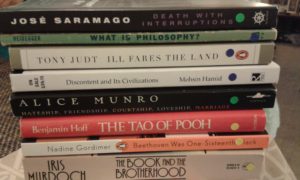
The books I read in 2016

Published by Bulatlat

1. Open Secrets, Alice Munro. I think there is a Munro Effect: A reader is initially lulled into thinking that a storyline is dull but it is only when the short story is about to end that he finally begins to see how he is completely immersed in the Munronian world.

2. Discontent and Its Civilizations: Dispatches from Lahore, New York, and London. Mohsin Hamid. The novelist as essayist treats the readers with his fascinating views on literature, politics during the War on Terror, and the ‘discontents’ of globalization.

3. People On Our Side, Edgar Snow. Difficult to read because of the horrors it exposed during the war against Fascism. An important historical record of Soviet military victory and China’s political situation in the 1940s.

4. What is Philosophy? Martin Heidegger. Who better to introduce philosophical concepts like being and truth than the great philosopher himself?

5. Beethoven Was One-Sixteenth Black and Other Stories, Nadine Gordimer. The stories here reflect the lives of South Africans during the post-apartheid era; but also a poignant portrayal of the human condition.

6. Ill Fares the Land, Tony Judt. The historian explaining the roots of our economic uncertainties, a progressive critique of modern politics and the socialist alternative.

7. Interpreter of Maladies, Jhumpa Lahiri. Stories of migrant families, Indians inhabiting strange places, individuals connecting with fellow human beings.

8. Hateship, Friendship, Courtship, Loveship, Marriage: Stories, Alice Munro. Love for all ages, romantic relationships that defy stereotypes, stories that affirm the enduring power of humanity.

9. The Tao of Pooh, Benjamin Hoff. Eastern philosophy introduced to the general public in a creative and entertaining format

10. Death with Interruptions, Jose Saramago. Always impressed with the imagination of the author, his realistic depiction of the social condition, his belief in the strength of individuals.

11. Babae, Obrera, Unyonista: Ang Kababaihan sa Kilusang Paggawa sa Maynila (1901-1941), Judy Taguiwalo. The situation of women workers and the role of unionism during the first half of the 20th century.

12. The Book and the Brotherhood, Iris Murdoch. Less about the Marxist book in the novel but more about the ‘brotherhood’ of intellectuals, their middle-class/middle-age issues, and how they tried to overcome the crisis in their lives. Typical Murdochian.

13. Mrs. Dalloway, Virginia Woolf. First person narrative of what transpired on a single day in early 20th century London.

14. This Side of Paradise, F. Scott Fitzgerald. The world of a privileged young intellectual in pre-depression America.

15. Hidden From History: 300 Years of Women’s Oppression and the Fight Against It, Sheila Rowbotham. A short course on the early history of the women’s movement.

16. Displaying Filipinos: Photography and Colonialism in Early 20th Century Philippines, Benito M. Vergara Jr. An exposition of the colonial uses of various technological apparatuses.

17. The Best of A. Lipin, Jess Abrera. Philippine history in the past three decades through the political cartoons published by the country’s leading newspaper.

18. Philosophy Today #1, Jerry H. Gill. Bonus material here is an essay by philosopher Ludwig Wittgenstein.

19. Ang Hayop na Ito! Virgilio S. Almario. Not just for kids but also for everybody who wants to appreciate folk history and poetry.

20. The New Imperialism, David Harvey. Dissecting the militarism of the United States, the politics of empire building, and the global contradictions it engenders.

21. Love in the Time of Cholera, Gabriel García Márquez. The social history of a previous era through the perspective of a man determined to win the love of his life.

22. The Little Prince, Antoine de Saint-Exupéry. The touching story of a dreamer, an imaginative sketch of our world, a plea for hope.

23. Tales for Little Rebels: A Collection of Radical Children’s Literature, Julia L. Mickenberg. An overview of literature intended to educate a new generation of progressives. Interestingly, the previously ‘radical literature’ is now part of mainstream culture. An obvious legacy of radicalism in contemporary society.

24. Greenwash: The Reality Behind Corporate Environmentalism, Jed Greer. Beware of so-called green initiatives which mask the plunder and dirty activities committed by transnational companies and their local apologists.

25. Planet of Slums, Mike Davis. Unmasking the real impact of capitalism and blind worship of the free market in urban societies.

26. The Audacity of Hope: Thoughts on Reclaiming the American Dream, Barack Obama. Here is Senator Obama unveiling his liberalness, his confident belief that he is an agent of progressive change. An overview of American electoral politics.

27. Sebyo, Carlos Humberto. A proletarian novel elucidating the principles of the national democratic struggle amid the decay of Philippine society.

28. The Point is to Change it: An Introduction to Marxist Philosophy, John Molyneux. Suggested reading material for all those who want to learn more about Marxism, its basic tenets, historical legacy, and continuing relevance.

29. Chronicles of Interesting Times, Gregorio C. Brillantes. Creative non-fiction essays on Philippine history, literature, and politics.

30. In the People’s Republic: An American’s First-Hand View of Living and Working in China, Orville Schell. An American academic narrating his observations of China during the Cultural Revolution.

31. Amusing Ourselves to Death: Public Discourse in the Age of Show Business, Neil Postman. Written three decades ago but still applicable today as TV continues to deaden the minds of the future generation.

32. Republic or Empire: American Resistance to the Philippine War, Daniel B. Schirmer. Not all Americans supported the invasion of the Philippines. This book tells the story of the anti-imperialist movement which made a huge impact on American politics.

33. Recapturing Democracy: Neoliberalization and the Struggle for Alternative Urban Futures, Mark Purcell. Useful text to understand how neoliberal economics is destroying cities and how the grassroots can challenge the dominant pro-business paradigm.

34. Daughter of Fortune, Isabel Allende. The California Gold Rush made alive through the stories of migrants, adventurers, fortune-seekers, natives, people of color, lovers.

35. Undermining Patrimony: The Large-Scale Mining Plunder in Mindanao and the People’s Struggle and Resistance, Rural Missionaries of the Philippines. Unique for highlighting the struggles of the Lumad and the people of Mindanao against corporate mining. Unique because it featured testimonies from NPA leaders.

36. How to Write a Thesis, Umberto Eco. And also for those not writing a thesis but want to pursue research and other types of writing.

37. China and Socialism: Market Reforms and Class Struggle, Martin Hart-Landsberg. China is no longer adhering to socialist aims and more importantly, its market-driven reforms are destroying the lives of the poor not just in rural China but also in neighboring countries.

38. The Bell, Iris Murdoch. Individuals dealing with various psychological problems as they try to build a religious community. A novel, a semi-philosophical treatise, a Murdochian book.

39. The Name of the Rose, Umberto Eco. Historical novel about a murder in a medieval abbot. But the book is also a comment on modern scholarship.

40. The Old Man and the Sea, Ernest Hemingway. While reading the book, what I imagined were the childhood trips we took in a small fishing village in Unisan, Quezon

41. Sociology in the Age of the Internet, Allison Cavanagh. The author covers many topics that continue to engage academics about the sociological impact of the Internet in our world today.

42. The Pristine Culture of Capitalism: A Historical Essay on Old Regimes and Modern States, Ellen Meiksins Wood. An alternative reading of British capitalism, the formation of the capitalist state, and the rise of global capitalism.

43. The Zinn Reader: Writings on Disobedience and Democracy, Howard Zinn. Historian and activist exposing the myths of American propaganda, defending radicalism, and exhorting the people to continue the struggle for real democracy.

44. My Century, Günter Grass. A hundred years of German history from various witnesses.

45. Welcome to the Urban Revolution, Jeb Brugmann. An optimistic view of the urban revolution, a reminder for policymakers to balance the profit-motive with the need to co-develop societies with ordinary stakeholders.

46. Diego Rivera: A Revolutionary Spirit in Modern Art, Andrea Kettenmann. Portrait of an artist as an independence advocate, communist sympathizer, and communist cadre.

47. Einstein and Relativity, Paul Strathern. My problem is that before I read this brief profile about Einstein and his theories, I stumbled upon an article alleging that the scientific contributions of Einstein’s wife were ignored by mainstream scholarship.

Posted in education | Tagged , | Leave a comment